Have you ever ridden out of a dressage test feeling quietly pleased, only to check your result and suddenly decide the whole test was terrible?
A few minutes earlier, you may have felt proud that your horse stayed more relaxed, that you rode forward instead of cautiously, or that you improved a movement you had been working on at home. Then one number appears on your phone and those positives seem to disappear.
As an equestrian mindset performance coach, this is one of the areas I spend a lot of time helping dressage riders with: not just preparing mentally for competition, but managing what happens in your mind after you ride down the final centreline.
Because dressage competition scores are useful. They give us feedback, help us track progress and can determine qualifications and placings. Of course they matter. But how you think about that score, what you make it mean and how quickly you can move forward from a disappointing result are all part of your competition mindset too.
The goal isn’t to convince yourself that scores don’t matter. It’s learning how to care about your results without allowing them to control your confidence, your enjoyment or your belief that you’re doing a good enough job with your horse.
This was the focus of one of our monthly Compete with Confidence Club (CWC Club) Zoom, More Than the Score. It created plenty of honest discussion because so many riders recognise the same pattern: the score is rarely just a number. It can quickly become disappointment, comparison, pressure, confusion or self-doubt.
Your dressage competition score is a snapshot, not your identity
A score is a snapshot of one performance, on one day, under those particular conditions, from the judge’s position.
It can tell you something about that test. It cannot tell you your full potential, how hard you have worked, how much your partnership has improved or whether you deserve your horse.
Yet our brains can easily turn “I received this score” into “I am this score.”
A qualification benchmark can quietly become the line between “good enough” and “not good enough”. A lower percentage can make us believe we don’t belong at that level, are progressing too slowly, or have let our horse down.
Notice the difference:
“I received a disappointing score today.”
“Maybe I’m just not a good enough rider.”
The first describes an outcome. The second turns the outcome into a judgement about yourself.
You are allowed to be disappointed by your dressage competition scores without using them as evidence against yourself.
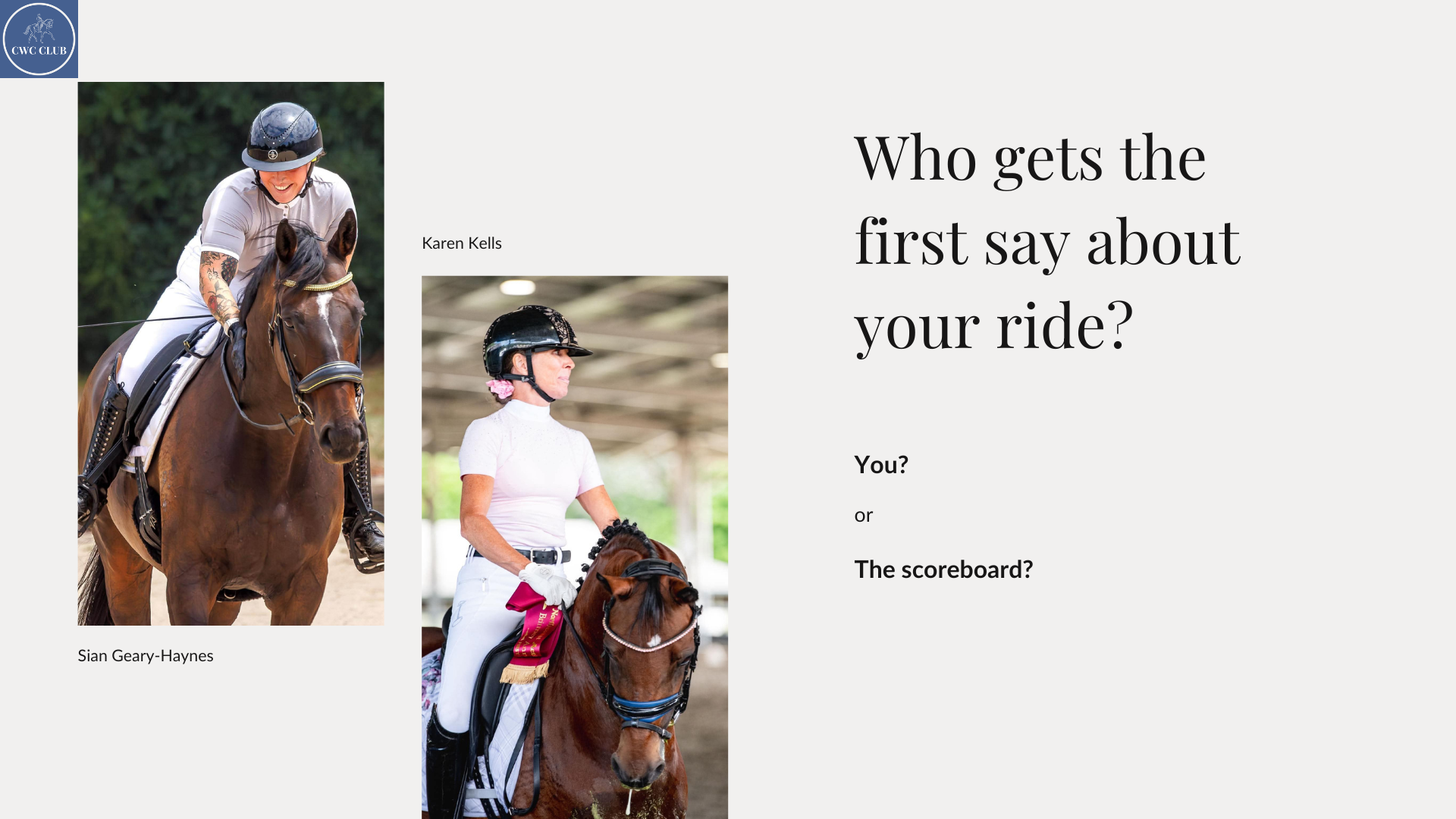
Who gets the first say about your ride?
One of the most practical changes you can make is to reflect on your test before checking the score.
When results appear online almost instantly, it is easy to reach for your phone automatically. But just because the score is available does not mean you need to look immediately, especially when you have another test to ride.
Before opening the results, ask yourself:
- How did the test feel?
- What went well?
- What would I improve?
- What am I proud of?
It only needs to take two minutes while you walk back to the float. You might even write down your answers.
This gives you the chance to form your own balanced opinion first. Once you have seen a disappointing result, it can be surprisingly difficult to reconnect with the proud or positive feeling you had when you left the arena.
Your perspective does not replace the judge’s feedback, but it deserves a place beside it.
When your score does not match the feeling
Sometimes a test feels much better, but the percentage barely changes. At other times, a test feels messy and receives a surprisingly good result.
That does not automatically mean you or the judge are wrong.
Your experience in the saddle and the dressage score may be measuring slightly different things. Your horse may have felt more relaxed, but the test lost accuracy or expression. You may have produced your best-ever leg yield, yet other movements carried more mistakes. Something that felt enormous to you may have looked minor from the judge’s box, or the opposite.
Rather than jumping straight to “the judge got it wrong” or “I clearly have no idea what I’m doing”, try curiosity:
- Did the improvement I felt show across the whole test?
- Did greater relaxation come with less energy or accuracy?
- Is the same feedback appearing across several tests and judges?
- Would a video help me understand the difference?
Look for patterns over time, not a final verdict from one test.
Do you want the score? Or need it?
Wanting good dressage competition scores is not the problem.
You are allowed to want 65%, 68%, 70%, a qualifying result or a place. Clear goals can be motivating. The pressure becomes heavier when you need the result to prove something about yourself:
“I need this score to prove I belong at this level.”
“I need this result to prove I am a good rider.”
“I need this percentage to prove I am a good enough rider for my horse.”
This is where mindset work can make such a difference. The score itself hasn’t changed, but changing the meaning you attach to it can completely change the pressure you carry into your next test.
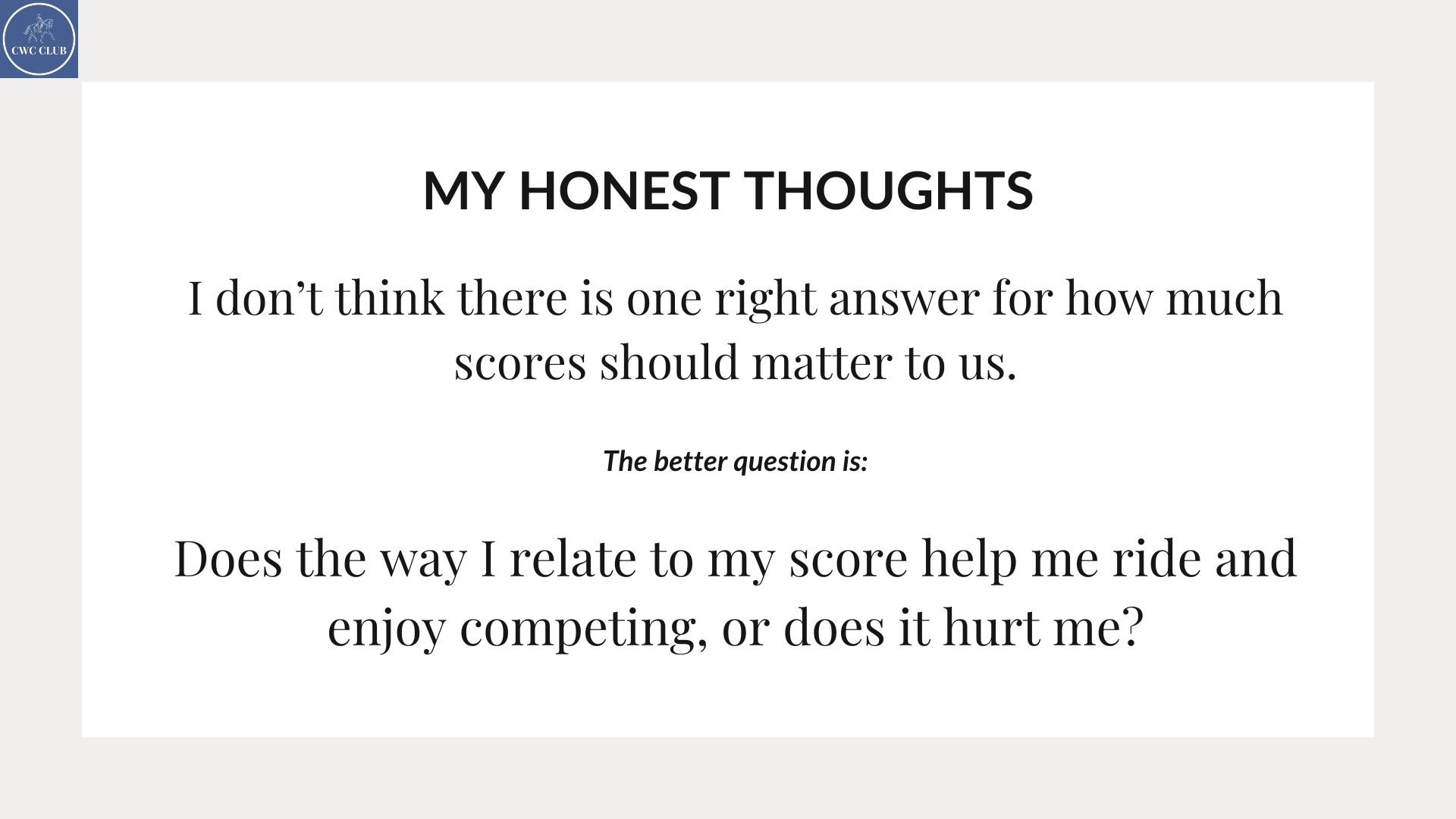
Ask yourself: Do I want this score, or do I need this score to mean something about me?
Healthy performance pressure helps you prepare and focus. Unhealthy pressure often makes riders tighten, become overly careful and ride to avoid mistakes rather than create a confident test.
Even a great result can create pressure when it becomes the new minimum you believe you must repeat. A personal best is evidence of what you and your horse can produce, not a standard you must meet every time.
Read the whole test sheet
Many riders scan a sheet filled with 6.5s and 7s, then fixate on the single 5.5.
Our attention sticks to what feels disappointing, so the lowest mark can start to outweigh everything that went well. Make a conscious effort to read the whole sheet and let the good marks count too.
Judges’ comments can also appear heavily focused on problems because the judge has limited time and space to explain why a mark was not higher. That does not mean they thought your entire test was poor.
Equestrian Australia explains that judges provide marks for each movement, along with comments designed to help riders improve their performance.
Try placing feedback into three buckets:
Take it on: It feels useful and relevant now.
Park it: It may be useful later, but it is not your current priority.
Investigate it: It keeps appearing and is worth discussing with your coach or reviewing on video.
Respect the feedback and look honestly for repeated patterns. But do not hand your entire self-belief to one person’s view of one test.
You are more than your dressage competition scores
A disappointing result may still hurt. A great one can still feel wonderful. The aim is not to stop caring about results. It is to build a steadier relationship with them.
Inside the Compete with Confidence Club, this is the kind of competition mindset work we explore each month: helping riders manage pressure, recover from disappointment, build confidence and develop the mental skills to perform more consistently when it matters. Our More Than the Score session was a reminder that dressage competition scores can guide your growth without deciding your worth as a rider.
At your next competition, pause before checking the scoreboard and ask:
What do I know about this ride before anyone else gives me their opinion?
Your answer matters too.